A holiday request from one of our Directors

When Fornetto became available on the French market, Peter, our European Operations Director asked me to prepare a traditional French apple pie or tart for a blog. A client in France thought it would be a nice idea and I said “Sure, no problem!”. After having done some research however, I discovered that France has a panoply of apple pies and tarts to choose from, all very different depending on the region, occasion, and style of cuisine. Some are very rustic and some are quite complex. Some take their influence from German origins while others are quite Mediterranean. Some are layered with custard and others with apple sauce. Some are baked upside down, some have pastry lids, some are topped with crumble and some are geometrically arranged with apple slices on the surface. So, which to choose?

A friend of mine is from the north of France though she’s lived in many different regions so I asked her for her input. Her answer was as follows, “I like the “classic” apple tart the best – it’s found throughout France”. I liked her answer because it’s actually a very eye-catching tart with the apples all laid out in concentric circles over the surface. It’s sure to delight everyone around your table, whatever the time of year. Let’s take a look!

The shopping list is quite simple. You’ll need puff or shortcrust pastry for the base. I used puff but shortcrust is more traditional. Soft fleshed apples like Gala or Fuji, lemon, sugar, cinnamon and vanilla for the apple sauce filling. Ginger jam or jelly for the glaze (any light coloured jam or jelly work well, like apricot for example however, ginger and apple go well together and add an even bigger holiday taste when combined with the cinnamon and vanilla) and a more robust apple, like Granny Smith, butter and sugar for the apple slice layer.

It’s important to bake the crust before filling it with the sauce and the apples or you’ll end up with mush. Bake it in a 200C (390F) Fornetto oven, kamado, smoker (or a conventional oven) for 20 minutes, remove it, glaze it and allow it to cool. Lower the heat in the Fornetto to 190C (375F) for baking the tart later on. While you have the crust baking, make the apple sauce filling and allow it to cool. Click here if you want to view the recipe now!

Once the sauce is done, prepare the apple slices by sautéing them in the butter with the sugar.

On the left hand side of the image are the apple slices before they’ve been sautéed. They should be about 3-4 millimetres (about an eighth of an inch), peeled and core removed. On the right of the image are the sautéed apple slices. Sauté them in the butter just long enough to make them pliable but not mushy.

Fill the glazed crust with the apple sauce and place the apple slices in concentric circles on the surface. Dust the apples lightly with confectioner’s sugar and bake the tart in the centre of the Fornetto at 190C (375F) for about 30 to 45 minutes. Move the tart to the top most position of the oven to allow the apples to darken around the edges if they aren’t darkening in the centre of the oven. Only allow them to darken on the edges, don’t allow them to burn!

Using your safety gloves, remove the tart from the oven and place it on a wire rack. Glaze the top of the apples and allow the pie to cool before cutting it.

Here you have it, a classic French apple tart that will definitely impress your guests. Click here for the full recipe!

To serve it, dust it lightly with confectioner’s sugar and serve it with vanilla or caramel ice cream. Delicious!

You’re in for a treat. Enjoy!

A festive spiral side dish!

This is a quick blog for everyone because I realise that we are all busy with the holidays; however, I really wanted to share this with all of you in case any of you are looking for a side dish that really stands out. It’s the time to be festive and this side dish has everything you need and want to accompany any roast you may be preparing. It’s a mix between a potato casserole (where the potatoes have been finely sliced and layered with cheese and onion) and a quiche. It’s intricate and beautiful.

I’ll admit that it takes a bit of time to prepare; however, the results are truly breathtaking! It’s a spiral of vegetables and cured ham that culminates in a roll that’s nestled in a crust of puff pastry and surrounded by a creamy and cheesy egg mixture that pulls it all together.

Here are some of the ingredients you’ll need:

Squash (like butternut for example), zucchini (courgette), sweet potato, white potato, carrots (orange and purple if you can find them), eggs, grated Grana Padano cheese, whole cream and dry-cured ham such as Iberico, Serrano or Prosciutto. (The ham can be left out to turn the pie into a lacto-ovo vegetarian dish as well.)

If you have a mandolin, use it to slice everything lengthwise and evenly. If you don’t, use a knife and try to cut everything thinly, about 2 mm (1/16 of an inch) thick. Blanch all the vegetable slices in salted boiling water for one minute and stop their cooking by plunging them into ice water, keeping all the vegetable types separate.

Click HERE to read the recipe now!

Line the Fornetto pie dish with parchment paper and prepare the pie.  The Fornetto Oven, or your kamado, smoker or conventional oven should be preheated to 180C (350F).

What makes this dish really eye-catching, besides the fact that the vegetables are swirled inside a puff-pastry shell, is the fact that the purple carrots bleed into the other vegetables and makes it very exotic looking. If you can’t find purple carrots, try beets. They share their colour just as easily as the carrots do!

Once you’ve allowed the pie to cool, remove it from the pie dish. It will come out effortlessly because of the parchment paper. Be sure to serve it whole at the table and slice it in front of your guests.

When you slice it, you’ll notice all of the different colours and layers formed by having rolled up the vegetables before putting them in the pie shell. All this is held together with the cheese and egg mixture and despite this, the pie remains light; unlike a more dense quiche. You can easily serve it as a main as seen above with a salad on the side or as a side dish to accompany a hearty roast. After all, it’s basically is all the ingredients of normal side dishes literally “rolled” into one!

From the entire team at Fornetto, we wish you a Happy and Healthy Holiday with this colourful rendition of “classic sides” rolled into one!

You’re in for a treat. Enjoy!

Braised Beef Shank at its best – Beef Ossobuco

If you’ve ever eaten in a fine Italian restaurant, you would surely have seen Ossobuco or Osso Buco on the menu. Traditionally speaking, Ossobuco (Ossobuco in bianco), a dish native to Milan is made with veal shank and vegetables and is cooked in a mixture of white wine and broth. It’s flavoured with cinnamon, bay leaves and gremolata (a very finely chopped mix of flat-leaf parsley, garlic and lemon peel). In Italian, Ossobuco means “bone with a hole” which describes the marrow bone located in the centre of the generally tough and fibrous leg meat.

For this recipe, I’m going to use beef instead of veal for the simple reason that I want a very rich beef flavour in the end. As I mentioned, Ossobuco refers to the cross section of bone in the centre of the cut of meat. This is a marrow bone and as the meat cooks, the marrow softens and becomes quite buttery. We’ll talk more about this below.

I used the word braised in the title of this post and for a good reason. Braising is a cooking technique that involves two types of cooking; dry heat and wet heat. When braising anything, especially meat, you begin by frying it over very high heat in order to sear the surface. The meat is then placed in a stew pot or casserole where liquid is added to cover most of it and it cooks on low heat for a long period of time.

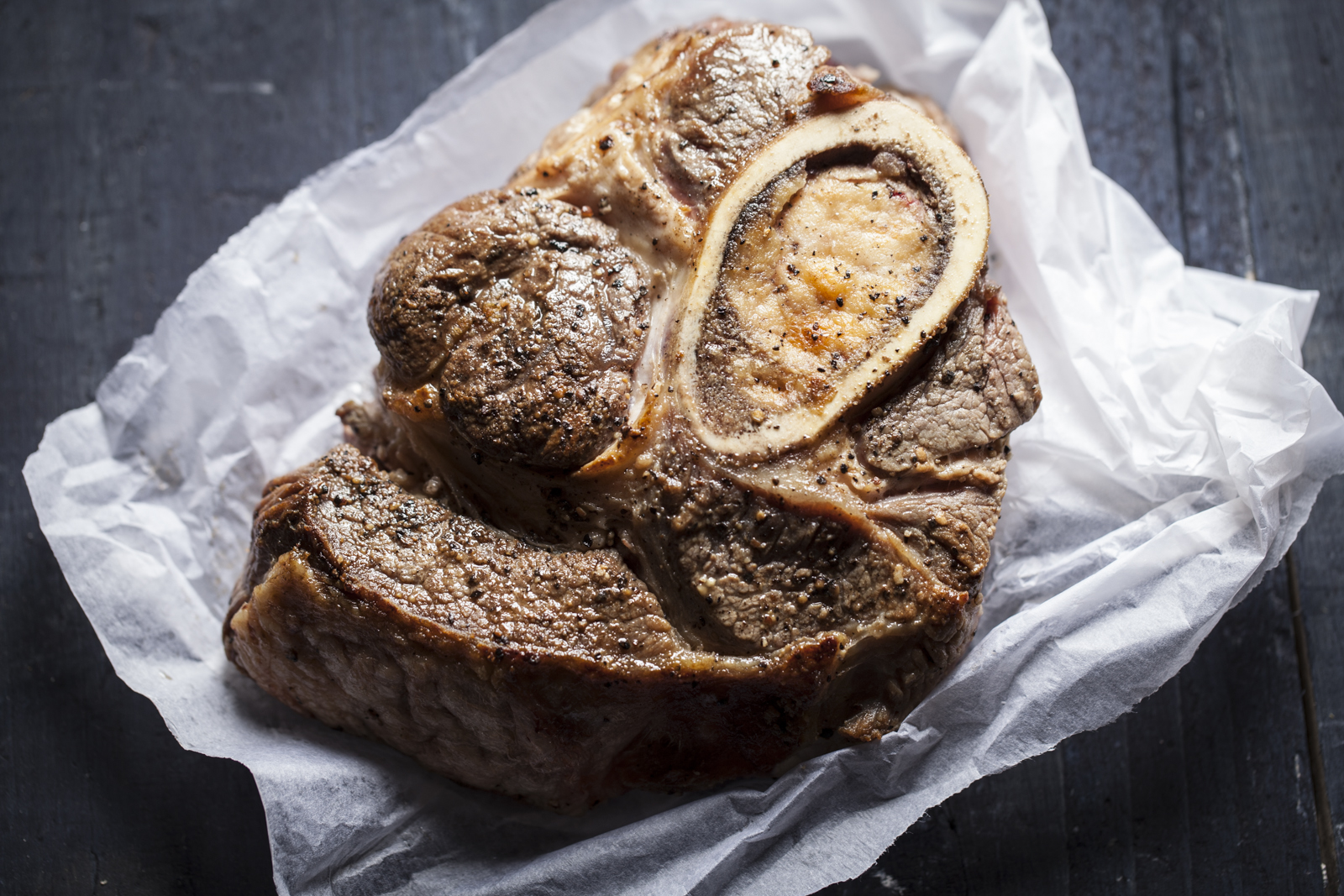
So what exactly does braising accomplish? Tougher cuts of meat are generally the fibrous parts of the animal where the muscles were used extensively during the course of its life. They are high in collagen content and when they are cooked quickly, this toughens and gives you a cut that’s very tough and chewy which is less than desirable. By allowing the meat to cook for an extended period of time, you give the collagen a chance to break down and convert to gelatine, a substance that’s also naturally found in bone, as the meat tenderises. In the image above you have an example of the colour you’re wanting after having seared the meat. Be sure not to allow it to brown too deeply or to harden to a crust as no mater how long you cook meat that’s been over-seared, it will never soften up. A light golden hue on the meat suffices.

When the meat has been fried, continue on to lightly fry the vegetables, all of them except for the potatoes. Frying the vegetables prior to cooking them in the stew pot will deepen and change their flavours dramatically giving you a richer flavour in the stew. Place the meat and the chunks of raw potato in the pot first and add in the lightly fried vegetables over top. Click here to view the full recipe now!

It’s now time to prepare a roux of flour and butter and to create the wine and beef broth gravy in which the meat will stew (you can refer to the recipe now to learn how to create a roux; click here). Because I only add salt and pepper and don’t dredge my meat in flour before frying it in this recipe, the roux is important in order to give the gravy more body and consistency.

Bake the beef Ossobuco in a preheated 170C (340F) Fornetto oven, kamado, smoker or conventional oven, and be sure that the stew pot is centred in the oven by either moving the rack up or down.

Bake for at least 3 hours without opening the door and after the 3 hours have elapsed, test the meat by trying to pull it away from the bone. If the bone falls away from the meat easily, it’s done. If not, place the lid back on the pot and continue cooking the stew checking it regularly until the meat is completely tender and done.

After having stewed the entire mixture, you’ll notice that the vegetables will have fallen, rendered much of their liquid and added to the wine and broth mixture, leaving you with a flavourful and rich gravy to spoon over the meat and veggies when you serve them.

As I stated earlier, the collagen in the meat will have broken down during cooking and will leave you with incredibly tender meat that will pull apart or cut with a fork with ease!

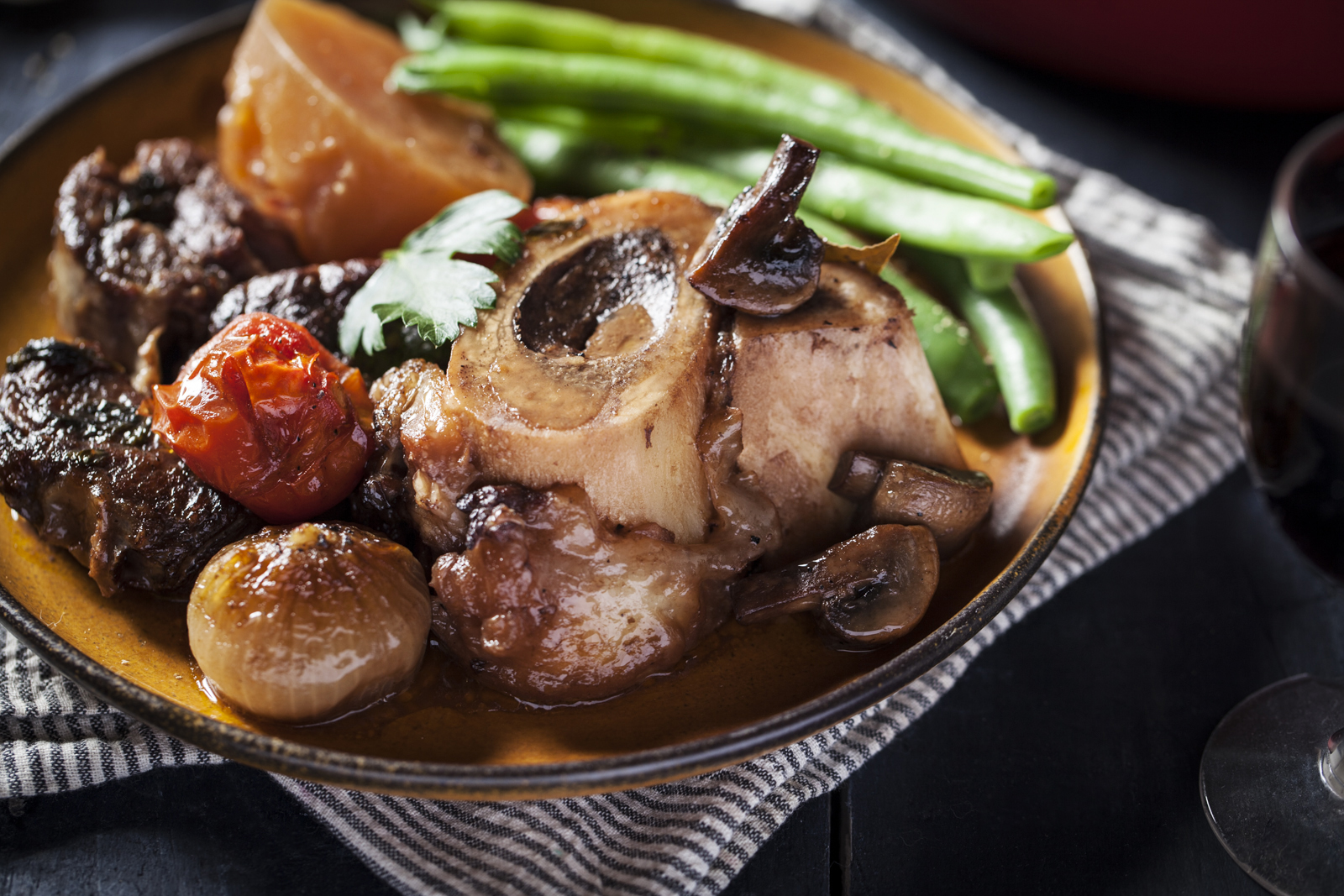
My favourite part of Ossobuco, and this rings true for very many people, is the buttery marrow inside the bone. There isn’t very much of it, that’s the only downside in fact however, spread like butter on bread and sprinkled with rock salt, it’s a huge treat. Don’t screw your nose up at it without having tried it first. It’s very delicate in flavour and absolutely delicious!


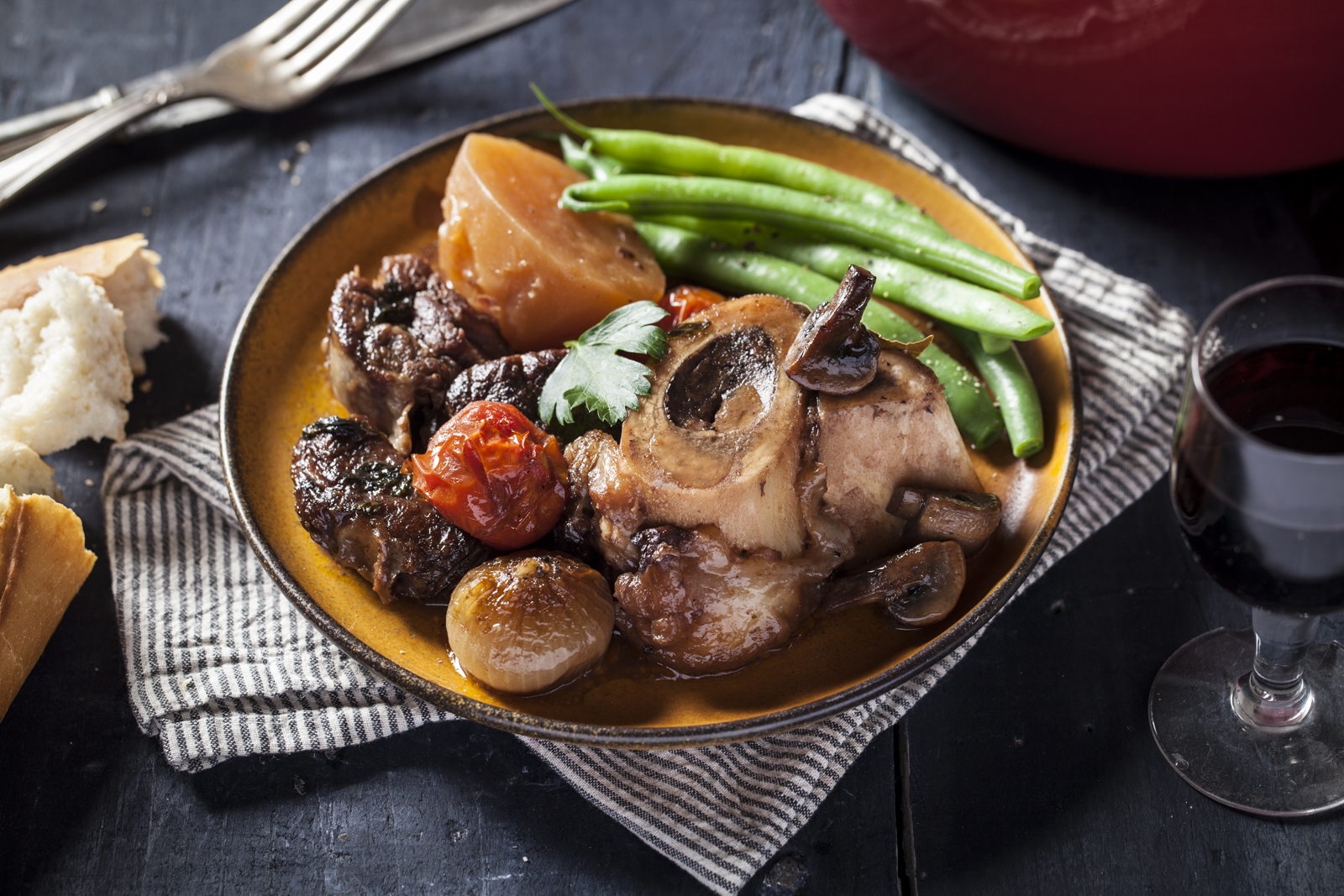
There you have it, Ossobuco done with beef and red wine. Nothing could be further from the traditional Milanese veal version but there are also very few things that beat this particular beef stew! Serve it up with a side of your favourite greens and crusty bread on the side.

You’re in for a treat. Enjoy!

The charm, mystique and flavours of Marrakesh

Morocco has long been a popular destination for tourists and has of course evolved over the last few decades from a country that, to a Westerner, may have seemed so incredibly foreign, to a land that has both embraced 21st century technology and maintained their unique and beautiful culture.

As a country that still has a very prominent monarchy and with Marrakesh being a mainstay of the royal family, the city is scattered with palaces, regal abodes, beautiful parks, green spaces and perfectly manicured trees.

Don’t be fooled by some of the palm trees you’ll see when you go, however. Creatively camouflaging otherwise ugly 21st century technology has been turned into an art form; some of the palms are actually manmade telecommunication towers. Ingenious!

To the unknowing eye, this may seem like a scene from a lush tropical rain forest when in fact it’s right in the city centre at the technology park.

Bitter oranges grow all over the city and if you arrive in the spring, the trees are in full bloom and the air is ripe with the sweet smell of citrus blossoms reminiscent of jasmine. Interestingly enough, these oranges are only good for making marmalade as they are wickedly sour. The thousands of trees around the city produce tons of bitter oranges that are then collected by a Moroccan company and processed into export quality marmalade.

The parks and green spaces in Marrakesh are truly a sight to behold. The landscaping and manicuring is undoubtably world-class and truly beautiful.

Morocco is, in fact, only about 15 kilometres (9 miles) from the European Gibraltar coastline and can be seen on the horizon on a clear day. With just a quick flight or ferry, Morocco is easily accessible to many tourists visiting Europe wanting to see something unique. It is the ideal location for a long-weekend getaway when you’re yearning for something exotic with a friendly atmosphere.

The old city is littered with tiny passages and doorways that lead you into the world renowned Souk; an unbelievable network of alleys and passageways making up one of the largest street markets in the world.

The very early morning at the Souk is quiet but don’t let that fool you. As the day progresses, the passages becoming teaming with locals, vendors and tourists alike.

As one would expect, the Souk is still a place where you can barter to your heart’s content. Not knowing what was in store for me, I was pleasantly surprised during my entire time wandering aimlessly (the best way to do it, by the way) throughout the Souk. We found the merchants and locals to be very friendly, respectful and helpful and if you weren’t interested in what they were selling, that was just fine….”other tourists will buy it” many boasted, as they chuckled under their breath!

The mosques and architecture were impressive in the sense that you had a bit of everything scattered throughout Marrakesh. Ramshackle old places next to the magnificent mosques and palaces leading to super modern buildings in the newer part of town. The entire city seems a bit paradoxical; it’s truly amazing!

That being said, don’t let the outside of those old run-down buildings fool you from their exterior! Once inside, you’ll be amazed by the carvings and intricacy of how Moroccans like their interiors designed.

A close-up of the carved walls.

The food of Marrakesh, and Morocco in general, is very flavourful, mixing spices into rich blends and combining them with meat, poultry, seafood, fish and vegetables. They cook primarily using a tajine (click here to see our lamb tajine blog) and serve the stewed dishes with a selection of salads, flat breads and couscous.

Dinner in Morocco is hearty and bountiful. Here we started off with seven delicious salads, all of which were completely unique. They, of course, were accompanied by a traditional wholemeal flatbread.

The main course was a delicious chicken tajine served with olives, couscous and vegetables. I’ll show you how to cook this dish using the Fornetto Bread Cloche, but you could also use a tajine! As you can see in the image above, The Fornetto Bread Cloche is strikingly similar to an authentic earthenware Moroccan tajine and works just as well as a tajine ever could!

If a tajine is not your cup of tea, visit the night market where you can indulge in all those delicious Moroccan salads as well as beautifully grilled meat, poultry and fish.

As a Halal nation, Moroccans pride themselves in offering the freshest produce and meat available. A treat both for the eyes and the palette.

The spice market at the Souk is any cook’s wonderland. It’s like being a kid in a candy store. The aroma of spices is in the air and the vendors are creative types that will happily mix you up their favourite blend of an extraordinary Ras El Hannout (a Moroccan spice blend similar to a curry or Indian Garam Masala), like the one you’ll need for the recipe below.

Click here to view the recipe in full for our Moroccan Chicken, Preserved Lemon and Green Olive tajine!

You’re in for a treat. Enjoy!